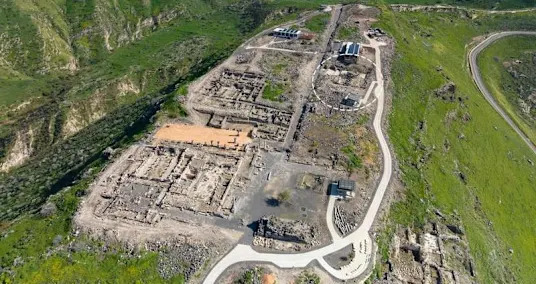
The project, launched by the Israel Antiquities Authority (IAA), aims to trace the origin of thousands of ceramic vessels even when the kilns where they were fired have long vanished.
A new Israeli research initiative is using cutting-edge scientific methods to solve one of archaeology’s oldest mysteries: where ancient pottery was made. The project, launched by the Israel Antiquities Authority (IAA), aims to trace the origin of thousands of ceramic vessels even when the kilns where they were fired have long vanished.
According to a recent IAA announcement, thousands of pottery vessels uncovered at excavation sites across Israel will now be examined with advanced scientific methods and catalogued as part of a joint project led by Dr. Anat Cohen Weinberger of the Israel Antiquities Authority and Prof. Alexander Fantalkin of Tel Aviv University.
The work is designed to create a distinctive “fingerprint” for each ancient production kiln, based on the mineral and chemical composition of pottery known to have been made there. The organizers said they envision a national database that would contain what they described as the “genetic sequencing” of the kilns, allowing researchers to propose a pottery vessel’s origin even when the kiln itself is absent at the excavation site.
Cohen Weinberger said in the statement that this absence is common.
“In most excavations, we find large quantities of pottery, but not the kiln where it was produced,” she said. Cohen Weinberger added that, without the kiln, archaeologists currently struggle to determine whether vessels were made locally or brought from elsewhere, calling that gap “one of the central challenges” in pottery research.

The IAA stressed that identifying a vessel’s origin is not merely technical. It describes provenance as a key to reconstructing cultural and economic links, trade networks, population movement, technological influence, and broader historical processes.
According to Cohen Weinberger, the first stage of the project focuses on pottery that can be tied to known kilns and analyzes it through two complementary scientific methods.
Methods to analyse origin of ancient pottery
One method is petrography, in which an ultra-thin ceramic slice of the vessel — about 30 microns thick — is examined under a polarizing microscope to identify minerals and rock fragments. The method can help link raw materials to the geological environment they came from and illuminate what it calls the potter’s “recipe,” the Antiquities Authority said.
The second method is chemical analysis using neutron activation analysis, or NAA. The IAA described this as testing a tiny ceramic sample in a nuclear reactor to measure elemental composition, including rare trace elements. The sample’s origin can then be proposed by comparing the results to pottery samples whose production sites are already known.
According to the IAA, the combined approach produces a unique profile for each kiln and can later be used as a reference point for pottery found at sites “without a kiln.” In those cases, the announcement says, researchers would compare an unknown vessel’s profile to the database and, if a match is found, propose where it was made, even if it was discovered far from the production site.
Cohen Weinberger said in the announcement that many pottery vessels tested in past studies remained without a known production origin because researchers lacked comparative data, and that the emerging kiln profiles could help address that problem.
According to the announcement, the research is being developed as a wide-scale national project. As part of it, the IAA said it is building a digital “kiln atlas” to consolidate the accumulated knowledge and make it available to researchers through a platform being developed by the authority’s digital technologies division. The statement says the atlas is intended to serve as a long-term research infrastructure for studying production, trade, and regional connections in the past.
Dr. Mechael Osband, head of the Petrography Laboratory at the Zinman Institute, University of Haifa, told The Press Service of Israel that the project was promising. He is not associated with the IAA’s initiative.
“This is a unique project with no parallel in other regions. It will provide an infrastructure for many studies dealing with different periods and will make a significant contribution to understanding economic and social connections in antiquity,” he told TPS-IL.
LATEST POSTS
- 1
 Mom warns of Christmas gift hazard as daughter recovers in hospital
 - 210 Picturesque Campgrounds That Will Raise Your Outside Involvement with American
- 3Catholic influencer shares death of 5-year-old son from 'severe' flu
- 4The Minimized Passage Horse: Reconsidering a Symbol for the Cutting edge Period
- 5There’s ‘super flu,’ COVID, RSV. Is it going around in SoCal?


- The most effective method to Pick the Right Volvo XC40 Trim for Your Way of life
- Merz postpones Norway trip for Belgium talks on frozen Russian assets
- Authentic Urban areas: Rich Legacy and Lively Societies
- Air superiority and long-range strikes: what China's war games say about how it might assault Taiwan
- Find Your Internal Culinary expert: Cooking Strategies and Recipes
- We may have one thing in common with jellyfish, new research finds
- Evidence of lost baptismal rite stage uncovered in Byzantine era cathedral near Sea of Galilee
- From a new flagship space telescope to lunar exploration, global cooperation – and competition – will make 2026 an exciting year for space
- Why do people have baby teeth and adult teeth?